
Most business owners do not wake up excited about debits, credits, journals, trial balances, or financial statements. They want to sell. They want stock to be correct. They want expenses captured. They want staff paid. They want to know whether the business is actually making money. Then, when the auditor, banker, investor, donor, or funder asks for proper financial reports, they want those reports to be ready.
That is the gap Maduuka is built to close. Maduuka gives everyday business teams a simple way to run operations while the Advanced Accounting module keeps the financial structure underneath. The cashier does not need to understand double-entry accounting to sell an item. The store manager does not need to know which ledger account receives cost of goods sold. The owner does not need to export everything to another system just to prepare reports.
The business runs in normal language. The books are prepared in accounting language.

Direct Answer
What does the Advanced Accounting module do?
It connects the day-to-day work your team already does — selling, buying, receiving stock, approving expenses, paying staff — to a properly structured accounting ledger. The result is a set of standard financial reports your accountant, auditor, bank, or funder can actually use, produced from the same system that runs the business.
The problem with separating operations from accounting
Many businesses start with one system for sales, another for stock, spreadsheets for expenses, paper records for payroll, and QuickBooks or a similar package for final reporting. That setup sounds normal, but it creates a hidden problem: the accounting system is always behind the real business.
Someone has to re-enter sales. Someone has to summarise expenses. Someone has to adjust stock. Someone has to explain cash movements. Someone has to clean up customer balances. By the time the accountant finishes, the owner is looking at last month or last quarter instead of what is happening now.
It also makes audits harder. If the POS says one thing, the spreadsheet says another, and the accounting file says something else, the auditor has to spend time asking which record is the truth. Maduuka takes a different approach. The operational transaction and the accounting record are connected from the beginning. Sales, purchases, inventory movements, expenses, payroll, payments, transfers, fixed assets, and depreciation can all flow into the financial structure of the business. The reports are not an afterthought. They are produced from the same activity that runs the business every day.
Built around standard accounting discipline
International accounting standards expect financial information to be complete, consistent, understandable, and supported by evidence. Auditors and funders want records that can be traced from a report back to the transactions behind it. Maduuka's Advanced Accounting module is designed around that discipline.
It supports the foundations a serious accounting system needs:
- Chart of accounts structured by business type
- Double-entry posting through the general ledger
- Sales, purchase, expense, payroll, inventory, and asset postings
- Trial balance checks before period close
- Bank, till, and mobile money reconciliation
- Period controls and year-end close workflows
- Exportable reports for review, filing, and audit support
This does not replace professional judgment for complex tax, audit, or IFRS disclosure work. A business should still rely on its accountant or auditor where professional review is required. The point is that Maduuka gives them cleaner, better-structured records to work with. Instead of handing an auditor a pile of receipts and spreadsheets, the business can hand over reports that already look like accounting reports.
Reports That Matter
Reports auditors, banks, and funders understand
Auditors do not want guesswork. Funders do not want vague sales screenshots. Banks do not want verbal explanations of cash flow. They want standard reports that show performance, position, movement, and supporting detail. Maduuka produces them from the same activity that runs the business.
General ledger
Every posted transaction, traceable back to the source document, with running balances by account.
Trial balance
Debit and credit totals checked across all accounts so problems surface before the auditor finds them.
Profit and loss
Revenue, cost of sales, expenses, and net result by period, branch, or department.
Balance sheet
Assets, liabilities, and equity as at a specific date, structured the way professional reviewers expect.
Cash flow statement
Operating, investing, and financing cash movements so owners see whether profit is becoming cash.
Inventory valuation
Stock on hand at cost, by branch, by warehouse, and by category, ready to tie back to the balance sheet.
Customer and supplier statements
Receivables and payables aging with full transaction history per account.
Reconciliations and asset reports
Bank and mobile money reconciliations, fixed asset registers, and depreciation schedules.
Why you do not need QuickBooks on top of Maduuka
QuickBooks is popular because many businesses genuinely need proper accounts. That need is real. But for most Maduuka clients, adding QuickBooks on top of everything else just creates another layer of work. The business runs in Maduuka, then someone still has to move the numbers into QuickBooks. That means double entry, an extra subscription, more reconciliation, and more dependency on someone technical enough to maintain the accounting file.
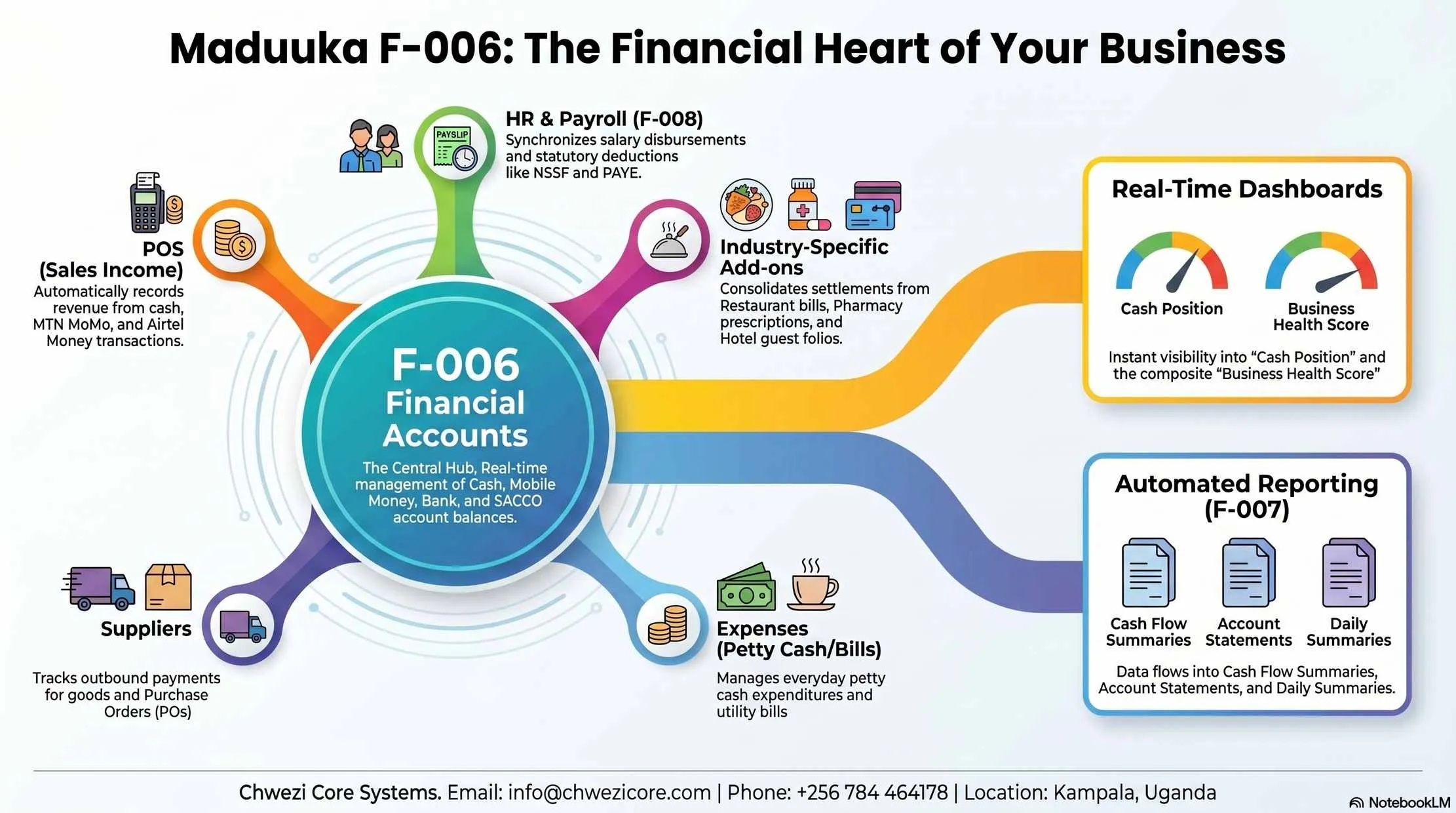
With the Advanced Accounting module, Maduuka brings the POS, the stock software, and the dashboard together in one product, and can become the system of record for both operations and accounting reports.

Why Many Clients Drop QuickBooks
Five reasons one system beats two
No double entry. Sales, stock, payments, and expenses are already in Maduuka — there is nothing to retype into a separate accounting file.
No second subscription. One platform covers POS, inventory, payroll, branches, and the financial reports your accountant needs.
No reconciliation gap. Operational records and accounting records share the same source, so reports stop disagreeing with the till.
No technical bottleneck. The team keeps working in normal business language while the ledger captures the accounting effect.
Auditor-friendly trail. Every report can be drilled back to the underlying transaction, document, and user.
Accounting power without accounting complexity
The strongest accounting system is useless if the team cannot use it. This is why Maduuka hides the technical accounting work behind simple operational actions. Staff do what they already understand.
Behind those actions, Maduuka routes the accounting effect to the right place using account mappings and posting rules. The cashier does not choose between revenue, VAT, inventory, cost of sales, cash, bank, receivables, or mobile money clearing accounts. The system applies the configured accounting treatment. The manager sees familiar business actions while the ledger receives the structured accounting record.
| Role | What they do | What the ledger gets |
|---|---|---|
| Cashier | Sells products and services at the POS. | Revenue, VAT, cash or mobile money, and inventory reduction are posted automatically. |
| Storekeeper | Receives stock and records transfers between branches. | Inventory value, supplier liability, and stock-in-transit accounts move correctly. |
| Manager | Approves expenses with attached evidence. | Expense accounts hit the P&L only after approval, with the supporting document on file. |
| Payroll officer | Runs salaries, deductions, and statutory contributions. | Wages, PAYE, NSSF, and net pay land in the correct payable and expense accounts. |
| Finance user | Records bank deposits, mobile money settlements, transfers, and customer payments. | Cash, bank, and mobile money clearing accounts reconcile against real statements. |
| Owner | Opens the reports. | Numbers are already structured the way an auditor, bank, or funder expects to see them. |

Designed for real African businesses
Many accounting tools assume the user is sitting at a desk, working in accounting language, and entering transactions after the fact. That is not how most African SMBs operate. A retailer may have several branches selling all day. A pharmacy needs batch and expiry tracking. A restaurant juggles table orders, kitchen tickets, stock deduction, and split bills. A hotel needs folios, city ledger accounts, and guest payments. A distributor needs supplier statements, credit customers, stock transfers, and mobile money collections.
Maduuka starts from those realities. It lets the business run the way it actually operates, then gives the back office the accounting structure required for serious reporting. A funder may not care how friendly the POS is — they care whether the numbers are credible. A cashier may not care about the trial balance — they care whether they can serve the customer quickly. Maduuka serves both sides.
Records That Drive Decisions
Better records make better businesses
Clean financial statements serve owners as much as auditors. They help owners answer the practical questions that actually move the business forward.
Are we making money or only making sales?
Which branch is actually contributing to profit, and which one is leaking?
How much cash moved through bank, mobile money, and till accounts this month?
Are stock losses or write-offs quietly eating margin?
Are customers paying on time, or is our debtor book growing?
Are we behind on supplier obligations?
Can we hand a funder or bank financial statements they will respect?
Can our auditor trace any number back to a real transaction?
FAQ
Questions business owners ask before switching
Does Maduuka replace QuickBooks?
For most small and mid-sized businesses, yes. Maduuka's Advanced Accounting module produces the same core reports businesses typically use QuickBooks for — general ledger, trial balance, profit and loss, balance sheet, cash flow, customer and supplier statements, and reconciliations — while keeping POS, inventory, payroll, and branch operations in the same system. Specialist tax or IFRS disclosure work should still involve your professional accountant.
Do my cashiers need to understand accounting?
No. Cashiers, storekeepers, and managers work in normal business language: selling, receiving stock, approving expenses, running payroll, recording payments. Maduuka applies the configured account mappings and posting rules behind the scenes so the ledger stays correct without the team having to know which account gets debited or credited.
Are the reports good enough for auditors, banks, and funders?
Yes. Maduuka follows standard accounting discipline: a structured chart of accounts, double-entry posting through the general ledger, period controls, reconciliations, and traceable transactions. That means the financial statements you produce look like the financial statements professional reviewers expect, and every figure can be traced back to the source operational record.
Can my external accountant still review the books?
Absolutely. Maduuka is built to make external accountants and auditors more productive, not to replace them. They can review structured reports, exportable journals, reconciliations, and supporting documents instead of cleaning up spreadsheets and re-keying data from receipts.
Will this work for multi-branch businesses?
Yes. Sales, expenses, stock movements, payroll, and assets can be tracked by branch, then rolled up into consolidated financial statements. Owners can see branch performance individually and the business as a whole without exporting to a separate tool.
What if I am not an accountant?
That is exactly who this is built for. Maduuka hides the accounting machinery behind familiar operational actions. You run the business. The ledger is prepared underneath. When you need formal reports, they are already there.
Next Step
See Maduuka run your business and prepare your books at the same time
Bring your real chart of accounts, your branches, your products, your payroll setup, and the kind of reports your auditor or funder asks for. We will show you the same business running in one place, producing the financial statements that used to require a second system.